

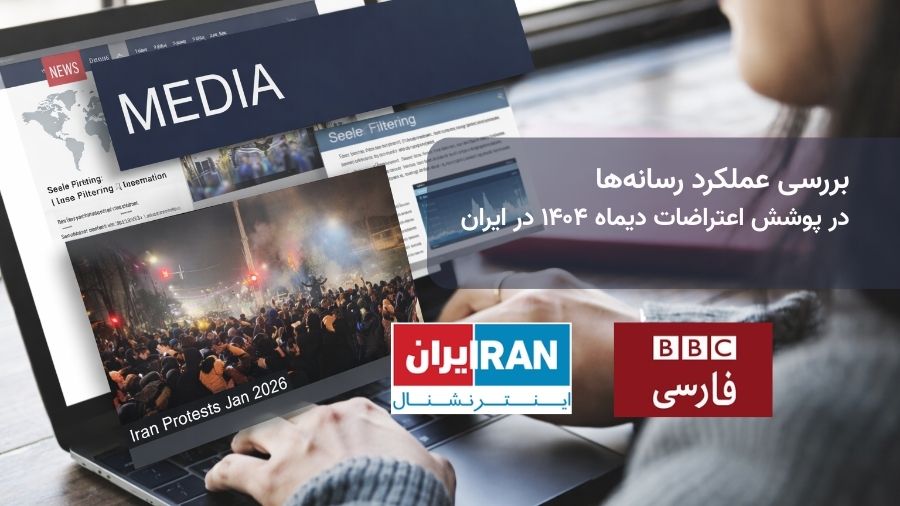
(Mean weight of various protest slogans; mean weight of slogans containing “Shah/Pahlavi”; an analysis of coverage by Iran International and BBC Persian)
Abstract:
This article (written in a format similar to a Working Paper—see Appendix 8) constitutes the first part of the explanation regarding our recent research-carried out in December 2025 and January and February 2026- on media performance in the news and analytical coverage of the revolutionary uprising (protests) of January 2026 (Dey 1404) in Iran. This study follows the examination and analysis of a total of more than 9,000 content items and includes the following:
An executive summary of results, introduction of research questions, research methodologies and their corresponding explanations, some of the most significant theoretical frameworks utilized in this study, the process of data collection, results (the weighting of slogans in the protests based on the analysis of available social media content, the performance of Iran International and BBC Persian, and a list of approximately 141 slogans from the protests), research limitations, the relationship between the research results and the “public’s” views, the correlation between slogans and political opinions in the recent protests and “in the streets” with the results of this study, the ratio of Shah/Pahlavi slogans to other anti-government slogans, some important aspects of the research, and recommendations for future studies.
Furthermore, in this text, we have clarified what subjects, questions, topics, or results this research does not address. It should be noted that in certain sections, aspects of the research are explained in greater detail to familiarize audiences who are less acquainted with the approach to media science and key topics in media analysis. This is based on our belief that there is a need for public education in this field, as many hold incorrect or incomplete conceptions, methods, or interpretations regarding media function, media analysis, or the interpretation of such analyses. Numbers in parentheses refer to the appendix numbers, all of which are provided at the end of the paper.
Executive Summary of Findings
- Slogan Weighting: Among approximately 4,500 unique videos and associated content analysed from social media, slogans containing the words “Shah” (King) or “Pahlavi” constituted approximately 17% of the total aggregate weight of all slogans. The remaining anti-Islamic Republic (IR) slogans (e.g., “Death to the Dictator,” “This is the year of blood, Seyyed Ali [Khamenei] will be toppled,” etc.) accounted for 83% of the total volume. The situational overlap between these two categories was 5.5%, meaning in only 5.5% of recorded instances were both types of slogans present in the same situation.
- Iran International: Our findings indicate that during the twenty-day period, 81% of Iran International’s output (on average) was dedicated to slogans or content promoting Reza Pahlavi—his ideas, programs, or affiliates. Compared to the 17% baseline found in the analysed protest videos, Iran International’s relative magnification of the “Shah/Pahlavi” narrative is approximately 376%.
- BBC Persian: BBC Persian’s output during the same period gave an average weight of 35% to slogans and content promoting Reza Pahlavi—his ideas, programs, or affiliates. Compared to the 17% baseline, BBC Persian’s relative magnification is approximately 105%.
- Revolutionary Nature: Our analysis of available videos and situations indicates that the slogans in this revolutionary uprising were directed against the entirety of the “Islamic Republic of Iran” (IRI). The slogans (and other observable elements) demonstrate that protesters sought the overthrow of the IRI system rather than mere reform. Furthermore, the diversity of slogans highlights a spectrum of suppressed socio-economic and political demands that citizens seek to fulfil specifically through the overthrow of the IRI (see Appendix 5).
- Comparative Bias: Even setting aside the 17% baseline, a comparison of the two outlets shows a significant political tilt. The absolute difference between their coverage weight (81% vs. 35%) is 46%, with a relative difference of 130%. This indicates that at least one of these outlets has a very steep political bias. While BBC Persian can be critiqued as a news outlet, Iran International functioned metaphorically as a political propaganda apparatus for Reza Pahlavi’s political line.
- Media Omission: Collectively, these two mainstream outlets either ignored or selectively omitted approximately 68% of the protest videos available on social media—the majority of which did not contain Pahlavi-related slogans. Furthermore, they covered only about 53% of the diverse range of slogans actually used during the protests.
(Remark:
This document is an English translation of the original Farsi text. While every effort has been made to ensure accuracy, due to utilizing machine translation and also noticing that not all parts of the Farsi version is translated, the Persian version remains the primary reference and possesses higher precision. In the event of any discrepancy or ambiguity between the two versions, the original Persian text shall prevail as the authoritative source.)
Contact via X and Instagram: @Mazdak5555
