


Iran Academia, formally known as the Institute for Social Sciences and Humanities (ISSH), has been operating since 2012 as an alternative, online, multi-platform, tuition-free university dedicated to expanding access to high-quality, free, and critical education for Persian-speaking communities inside and outside Iran. Focused on removing barriers to education in the social sciences and humanities, the institution has, over the years, worked through its academic programs, knowledge platforms, and scholarly networks in an international setting to sustain learning, research, and intellectual exchange under conditions of censorship, repression, and restriction.
The CIES conference—organized by the Comparative and International Education Society, a leading forum for research, practice, and the advancement of comparative and international education—is one of the most important international gatherings in the field. It brings together researchers, academics, and education practitioners from around the world to discuss experiences, ideas, and emerging models related to education, justice, peace, inequality, and global transformation. Iran Academia’s presence in such a setting was a significant opportunity to present the Iranian experience of independent and transnational education in the face of repression and restrictions on academic freedom.
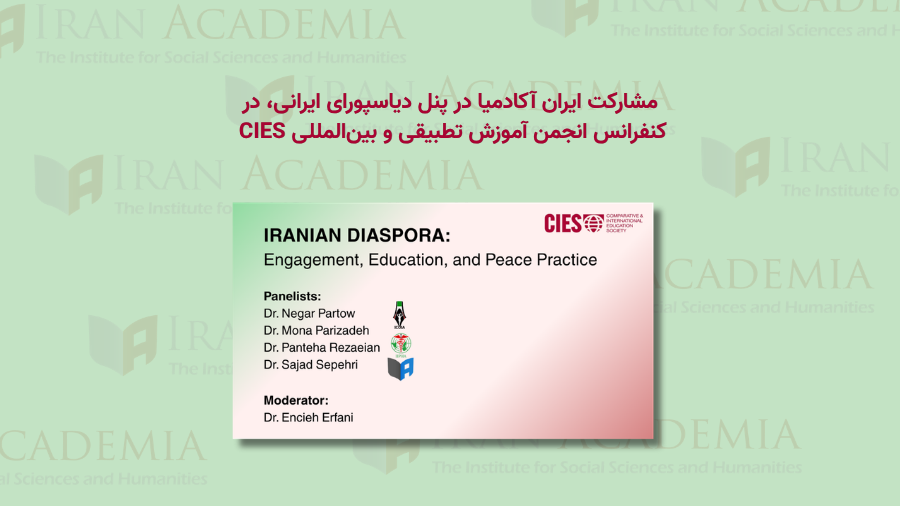
Within this context, Sajad Sepehri, Educational Development and Innovation Strategist and a member of Iran Academia’s executive team, participated on behalf of Iran Academia in a panel titled “Iranian Diaspora: Engagement, Education, and Peace Practice.” Held virtually, the panel brought together four Iranian-led initiatives in exile: Iran Academia, the International Community of Iranian Academics (ICOIA), ICOIA Online School, and the International Independent Physicians and Healthcare Providers Association (IIPHA). At the heart of the panel was the question of how Iranian scholarly and professional institutions and networks in exile sustain education, dialogue, knowledge circulation, and trust-building under conditions of repression and constraint, and how these efforts can become a capacity for peacebuilding and social reconstruction.
Sajad Sepehri’s presentation, titled “Bridging to Protection: Linking Exile Education with Scholars at Risk and Allied Networks,” focused on the experience of Iran Academia as a reconstructive, independent, transpartisan, and transnational academic institution. The presentation introduced Iran Academia as a living example of alternative education under repression: an institution that, by developing an ecosystem comprising a graduate school, a free and open online courses platform, a multimedia knowledge-exchange environment, an open-access publishing infrastructure, an international conferences platform, and a research center—while also securing international recognition for its academic qualifications, particularly in development studies and interdisciplinary social studies—has been able to provide Persian-speaking students, researchers, journalists, and civic actors with a space for critical education, intellectual exchange, sustained scholarly participation, trust-building, and the cultivation of continuity across fragmented conditions.
In the broader logic of the panel, Iran Academia was presented not merely as an educational institution, but as a durable and comparatively longstanding, pioneering component of a coordinated and voluntary ecosystem of Iranian initiatives in exile. Through education, mentoring, care, international linkages, and the design of secure learning environments, this ecosystem seeks to preserve the continuity of intellectual and academic life for Iranians inside the country who face repression, suspension, exclusion, or isolation. The panel underscored that such collaborations can be understood as a tested example of peace education under authoritarianism and crisis—a model that is highly significant not only academically, but also socially and institutionally.
Sepehri’s participation in the CIES conference should be understood as part of Iran Academia’s sustained effort to bring the Iranian experience of independent, multilingual, online, and transnational education into global conversations. It is an effort that simultaneously advances the defense of academic freedom, the development of intellectual, civic, and democratic capacities, and the strengthening and facilitation of pathways toward democracy through education. Iran Academia’s presence at this conference affirms that education in exile can become more than an emergency response; it can serve as an effective model for preserving scholarly ties, cultivating critical thought, and opening new horizons for the future of nations.