

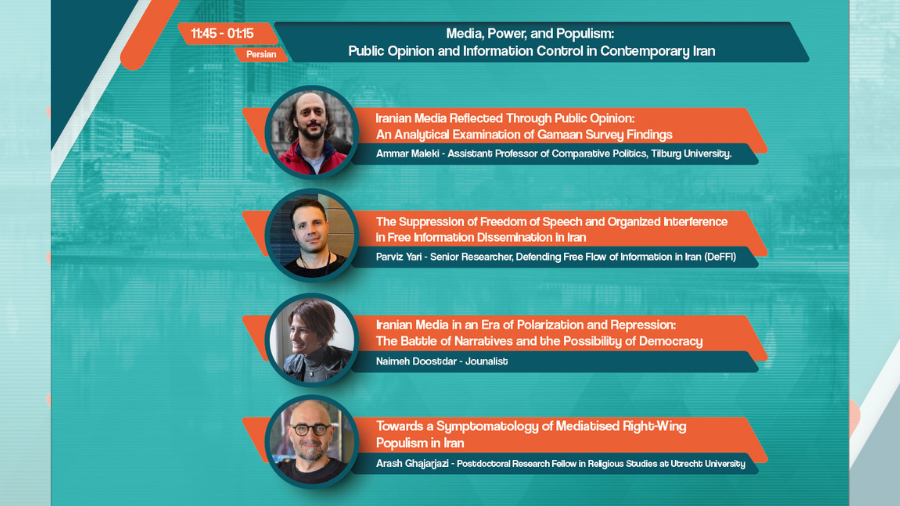
Iranian Media Reflected Through Public Opinion: An Analytical Examination of Gamaan Survey Findings – Ammar Maleki, Assistant Professor of Comparative Politics, Tilburg University. Director of GAMAAN research foundation.
The Suppression of Freedom of Speech and Organized Interference in Free Information Dissemination in Iran – Parviz Yari, Senior Researcher, Defending Free Flow of Information in Iran (DeFFI)
Iranian Media in an Era of Polarization and Repression: The Battle of Narratives and the Possibility of Democracy – Naimeh Doostdar, Journalist
Towards a Symptomatology of Mediatised Right-Wing Populism in Iran – Arash Ghajarjazi, Postdoctoral Research Fellow in Religious Studies at Utrecht University
Abstract
Iranian Media in an Era of Polarization and Repression: The Battle of Narratives and the Possibility of Democracy – Naimeh Doostdar
“In recent years—particularly since the “Woman, Life, Freedom” movement—Iranian media, both domestic and in exile, have taken on a dual function: they serve simultaneously as platforms for public awareness, hope, and the defense of civil rights, and as contested battlegrounds for clashing narratives of power and resistance. This paper draws on field experience and content analysis of mainstream and alternative Persian-language media to explore how censorship, information warfare, and psychological operations have disrupted the classical democratic function of the press as the fourth estate.
The paper begins by examining the transformation of the media role under authoritarian rule in Iran and then turns to the evolution and challenges of exiled media. It also investigates how social media platforms have enabled the formation of social movements and alternative narratives, with case studies such as the killing of Mahsa Amini and the coverage of nationwide protests.
Finally, the paper interrogates the ethical and professional dilemmas faced by journalists operating under conditions of surveillance, threat, and disinformation. By critically engaging with media theory and drawing from the Iranian context, this study asks: can Iranian media still function as tools of democratization, or have they themselves become part of a cycle that reproduces violence and polarization? The paper aims to contribute to a rethinking of media resistance in times of crisis and its role in democratic transitions.”
