


Abstract
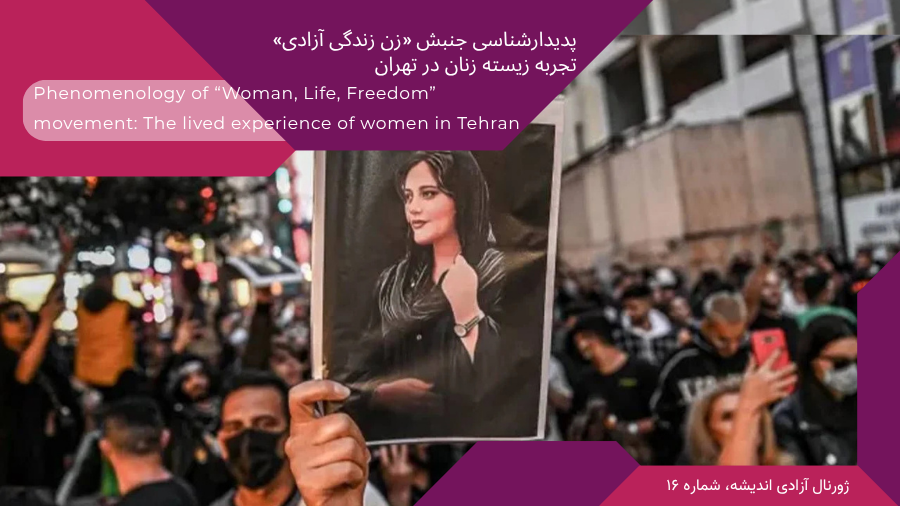
This research aims to take a look at the “Woman, Life, Freedom” movement from an internal perspective, with its main question being, “How have women in Tehran experienced the ‘Woman, Life, Freedom’ movement?” This approach considers the relative absence of such perspectives in the study of social movements.
To achieve this, the method of hermeneutic phenomenology, which aims to study the lived experiences of individuals, was chosen. In-depth interviews were conducted with six women residing in Tehran who were closely involved with the movement, and the Interpretive Phenomenological Analysis (IPA) method was employed to analyze the collected data. Findings include four main themes: (1) Rationale for Mobilization: Conflict between the private and public spheres / Patriarchal culture / The “Other”; (2) Obtaining Subjectivity: Collection of bodies / Physical harm; (3) Formation of revolutionary emotions but lack of organization / alternatives / representation of the opposition; (4) Enhancing gender equality and the dynamics of political consciousness and engagement.
Keywords
women life freedom, new social movements, hermeneutic phenomenology, lived experience
