


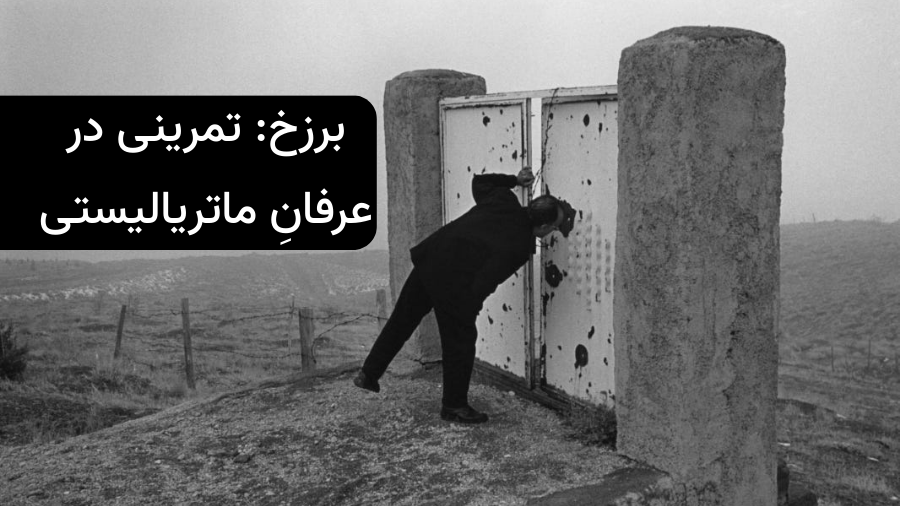
This article is a review of Joan Copjec’s book “Cloud: Between Paris and Tehran,” delves into a complex intersection of Islamic Sufism, Lacanian psychoanalysis, and the cinema of Abbas Kiarostami. The article argues that Copjec’s work reinterprets Sufi concepts, particularly those of Ibn Arabi, to reveal a novel understanding of reality.
It focuses on the paradoxical idea of a “cloud” or barzakh—a primordial barrier that is simultaneously a tiny material remnant, an immaterial space, and a veil. This “barzakh” is the “remnant of a remnant” from which the entire cosmos emerges, and it serves as the ultimate source of reality, a site of fundamental tension that allows for the creation of forms. The article contrasts this Sufi perspective with a radical Christian view, positing that while Sufism aims to return to a state of original purity, Christianity recognizes that the split between God and humanity is a gap within God Himself, with the “barrier” of a meaningless, pre-ontological chaos being the source of all things.
This profound analysis is then applied to art and life, suggesting that truth is not found behind a veil but is produced by the veil itself, an illusion illustrated by the ancient Greek painters Zeuxis and Parhasius. To read the original article in Farsi, please change the webpage language to Persian.
