


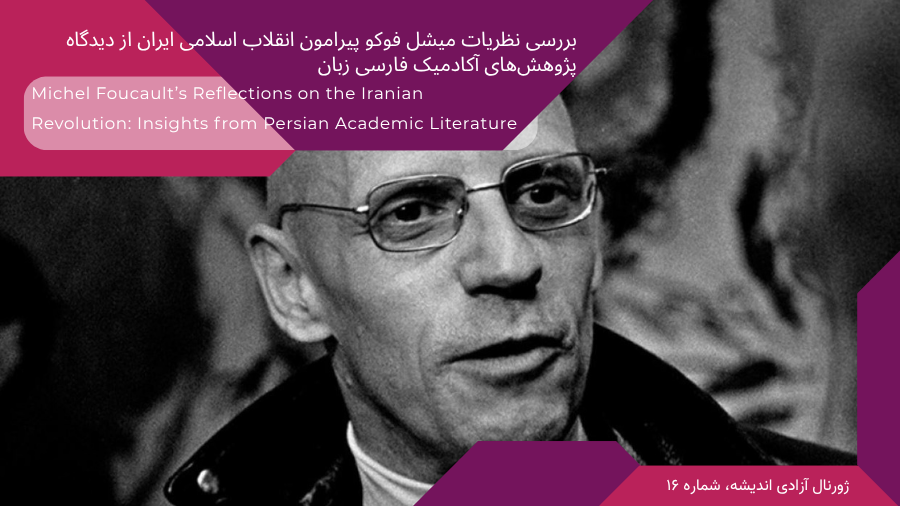
Abstract
With regard to 1979 Islamic revolution of Iran, several prominent scholars have analyzed this phenomenon of contemporary Iranian history; these scholars have identified the cause behind this revolution to be economic, political, sociological, cultural, psychological and …. However, one of the theorists who examined this revolution from a cultural perspective is the French philosopher Michel Foucault.
He regards the Islamic and Shiite culture as a potent driving force, and contends that, with their religious commitments, the Iranian people have engendered such a force that made the all-powerful Pahlavi regime to surrender to the will of the people.
In the present study, using a document-based research method, we aim to address the following questions: From the perspective of Persian-language scholarship, what are the theoretical roots of Michel Foucault’s views on the Iranian Revolution? How did Foucault, in general terms, evaluate this historical event?
And more specifically, how did he interpret the factors contributing to the revolution’s emergence and victory, its distinctive characteristics, and the nature of the Islamic government that resulted from it? However, in raising these questions, it is also acknowledged that much of the Persian-language literature— either due to ideological and political constraints or as a result of an uncritical reverence for Foucault’s stature in Western thought—has rarely engaged in a layered and critical examination of his position. Therefore, this study not only seeks to extract and analyze the dominant interpretations but also to uncover the gaps, generalizations, and analytical shortcomings within them.
Keywords
Foucault, the Islamic Revolution of Iran, Political Spiritualism, the General Will, Postmodernism
