


Abstract
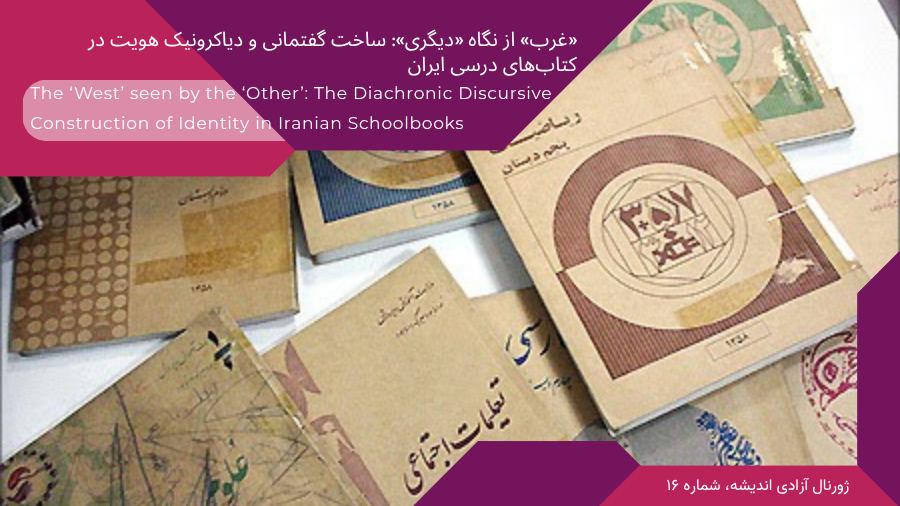
This article revisits the relational dynamics between the West and Islam and explores how “the West” has, in turn, been (re)presented and constructed as a multi-faceted “other” in Iran’s official schoolbooks. Drawing on an original diachronic corpus that compares textbooks from before and after the pivotal year of 1979, the study reveals schoolbooks as a critical site for the construction and consolidation of identity in international relations (IR).
This research contributes to the broader endeavour of identifying the sources and drivers of identity in IR, thereby building on and advancing the constructivist agenda. It highlights the significance of identity markers that transcend the state level and encompass alternative spatial, ethical, and temporal dimensions, focused respectively on civilisation, religion, and memory. At a time when the West is increasingly contested on a global scale, shedding light on this empirical material not only enhances our understanding of alternative worldviews and, in particular, perceptions of the West but also proves essential to both the theorisation and practice of IR.
Keywords
International Relations, Constructivism, Identity, Schoolbooks, Iran
